Fascinating Solar System

Finnegan Flynn
| 07-04-2026
 · Science Team
Introduction: A Cosmic Journey
The solar system is a vast and intricate collection of celestial bodies, each with its own unique story.
From the blazing Sun at its center to distant icy bodies at its edge, our cosmic neighborhood never ceases to amaze. Understanding these wonders offers insight not only into astronomy but also into the processes that shaped our planet. Observing planets, moons, and asteroids sparks curiosity and reminds us of the vastness beyond Earth.
The Sun: Our Radiant Star
The Sun dominates the solar system with its immense gravity and energy output. It contains more than 99% of the solar system's total mass and drives weather, climate, and seasons on Earth. Solar flares and coronal mass ejections are spectacular phenomena, releasing bursts of energy visible even from millions of kilometers away. These solar events influence satellite operations, communication systems, and even auroras, demonstrating the Sun's far-reaching impact.
Planetary Diversity
1. Mercury and Venus
Mercury, the smallest planet, experiences extreme temperature swings from scorching heat to freezing cold. Venus, cloaked in thick clouds, has a greenhouse effect so intense that surface temperatures can melt lead.
2. Earth and Mars
Earth remains the only known planet with abundant liquid water and life, while Mars intrigues scientists with evidence of ancient rivers, ice caps, and the potential for future exploration.
3. Gas Giants
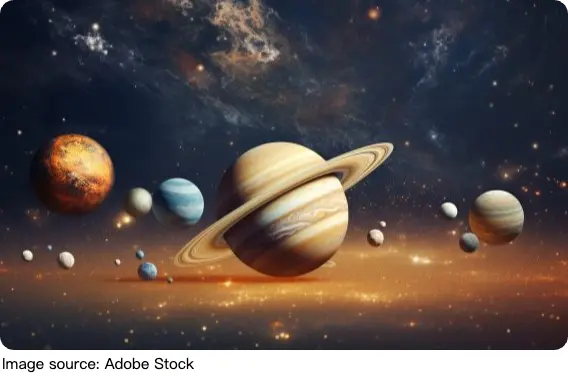
Jupiter and Saturn are immense gas giants with stunning atmospheres. Jupiter's Great Red Spot is a storm larger than Earth that has persisted for centuries, while Saturn's rings, composed of ice and rock particles, create one of the most iconic celestial images.
4. Ice Giants
Uranus and Neptune, colder and more distant, contain methane in their atmospheres, giving them distinctive blue hues. Uranus rotates on its side, creating unusual seasonal patterns, while Neptune has the fastest winds in the solar system.
Moons and Other Bodies
Many planets host fascinating moons. Jupiter's Europa is believed to harbor a subsurface ocean beneath its icy crust, making it a candidate for life. Saturn's Titan has thick, nitrogen-rich clouds and lakes of liquid methane. Beyond the planets, the asteroid belt and distant Kuiper Belt contain remnants from the solar system's formation, offering clues to its ancient past.
Cosmic Mysteries and Exploration
Humans have sent probes and telescopes to explore these distant worlds. Missions like Voyager, Cassini, and the Mars rovers have expanded our knowledge, revealing active volcanoes, massive storms, and complex geology. Continuous observation uncovers new phenomena, from comet tails to transient atmospheric events on planets, reminding us that the solar system is dynamic and ever-changing.
Reflection: The Wonder of Space
Exploring the solar system encourages curiosity and appreciation for the universe's complexity. Every planet, moon, and asteroid tells a story about formation, evolution, and cosmic forces. Observing these celestial bodies connects us to the larger cosmos, inspiring exploration and deeper understanding of the environment we call home. The solar system is not merely a collection of objects but a living laboratory of discovery, urging us to keep looking outward and questioning what lies beyond.