Space in Floristry

Amit Sharma
| 05-03-2026
 · Plant Team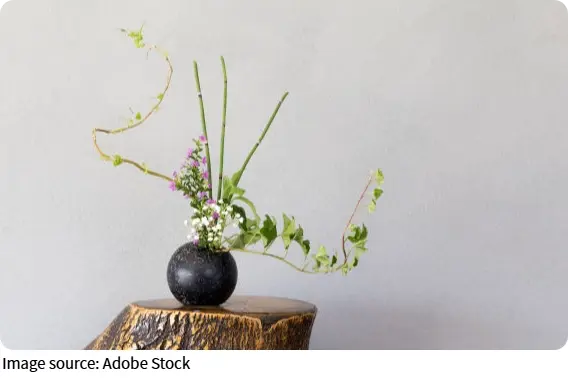
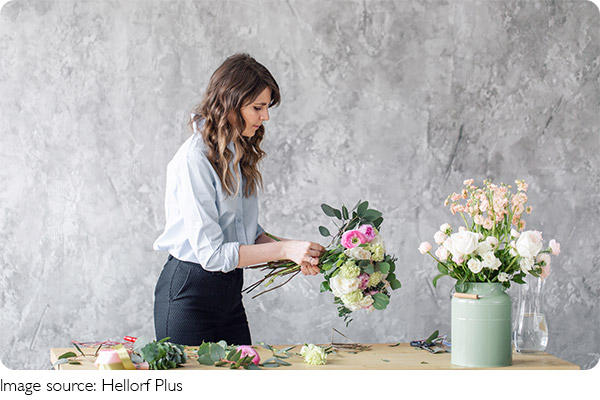
A common scene in beginner workshops: stems are trimmed, blooms are chosen with care, and one by one they are added to the arrangement.
Each flower is beautiful on its own. Yet when the vase is finally full, something feels heavy. The colors compete. The shapes blur. Instead of elegance, the result feels crowded.
What is missing is not another flower. It is space.
In floristry, negative space—the intentionally empty area between stems and blooms—is not a gap to be filled. It is an active design element. When used deliberately, it enhances structure, clarifies focal points, and gives the composition a sense of calm authority.
Why Space Is a Structural Tool, Not an Afterthought
Negative space works because the human eye needs rest. Visual perception research consistently shows that contrast and separation improve clarity. In floral design, this translates into improved legibility of each bloom.
1.Defining focal hierarchy
When every stem competes for attention, none stands out. By leaving measured gaps around a primary bloom—perhaps a single dahlia—you signal importance. Professional designers often begin with a focal flower placed slightly off-center, then deliberately keep surrounding areas lighter to maintain emphasis.
2.Creating depth through layering
Space between foreground and background stems introduces dimension. Instead of compressing all blooms into one dense mass, vary their placement: some closer to the viewer, some set back. The visible air between them creates spatial rhythm.
3.Enhancing line movement
Branches and linear elements need room to travel. Without space, their directional quality disappears. A curved branch that arcs upward only communicates motion if its silhouette remains visible against open background.
Space is therefore not emptiness; it is structure revealed.
Practical Methods to Avoid Overfilling
Overfilling is rarely intentional. It often comes from enthusiasm. A disciplined approach helps maintain restraint.
1.Start with fewer stems than you think you need
Professional florists frequently begin with a limited quantity and evaluate before adding more. If the arrangement already reads clearly from two meters away, additional flowers may dilute its impact rather than strengthen it.
2.Step back every five minutes
Distance reveals crowding. Place the arrangement on a table and step back several paces. If individual blooms are difficult to distinguish, remove one or two elements. Subtraction is often more powerful than addition.
3.Use container proportion as a guide
A useful rule in Western floral design suggests that the overall height of an arrangement should be approximately one and a half times the height of its container. While not absolute, this proportional guideline naturally encourages vertical breathing room and prevents compact density.
Restraint also depends on understanding mechanics. Floral foam, frogs, or chicken wire structures should support stems without forcing them into a tight cluster. When mechanics are too restrictive, spacing becomes difficult.
Balancing Density and Air
Negative space does not mean sparse or unfinished. The goal is equilibrium between fullness and openness.
1.Concentrate density in one zone
Allow one area—often the base—to carry visual weight. Surrounding areas can then remain lighter. This creates a stable foundation without overwhelming the eye.
2.Vary bloom size intentionally
Pair larger blossoms with smaller filler flowers, but separate them slightly. When scale differences are visible, the arrangement gains rhythm.
3.Respect the silhouette
Before adding the final stems, examine the outer contour. A clear silhouette against a wall indicates healthy spacing. If the outline appears bulky and undefined, selective removal restores clarity.
Many minimalist floral studios in European cities have embraced this philosophy. Their window displays often feature only a few dramatic stems in wide ceramic vessels. Passersby stop not because of abundance, but because the simplicity commands attention.
The discipline of leaving space requires confidence. It asks the designer to trust that one well-placed bloom can speak loudly enough. The temptation to fill every gap never fully disappears. But the moment you remove a single extra stem and the composition suddenly feels lighter, the principle becomes unmistakable.
Next time you arrange flowers, pause before reaching for another stem. Let the air remain visible. In that quiet space, the flowers will breathe—and so will you.